Chapter 1: The King of Smoke & The Queen of Silence
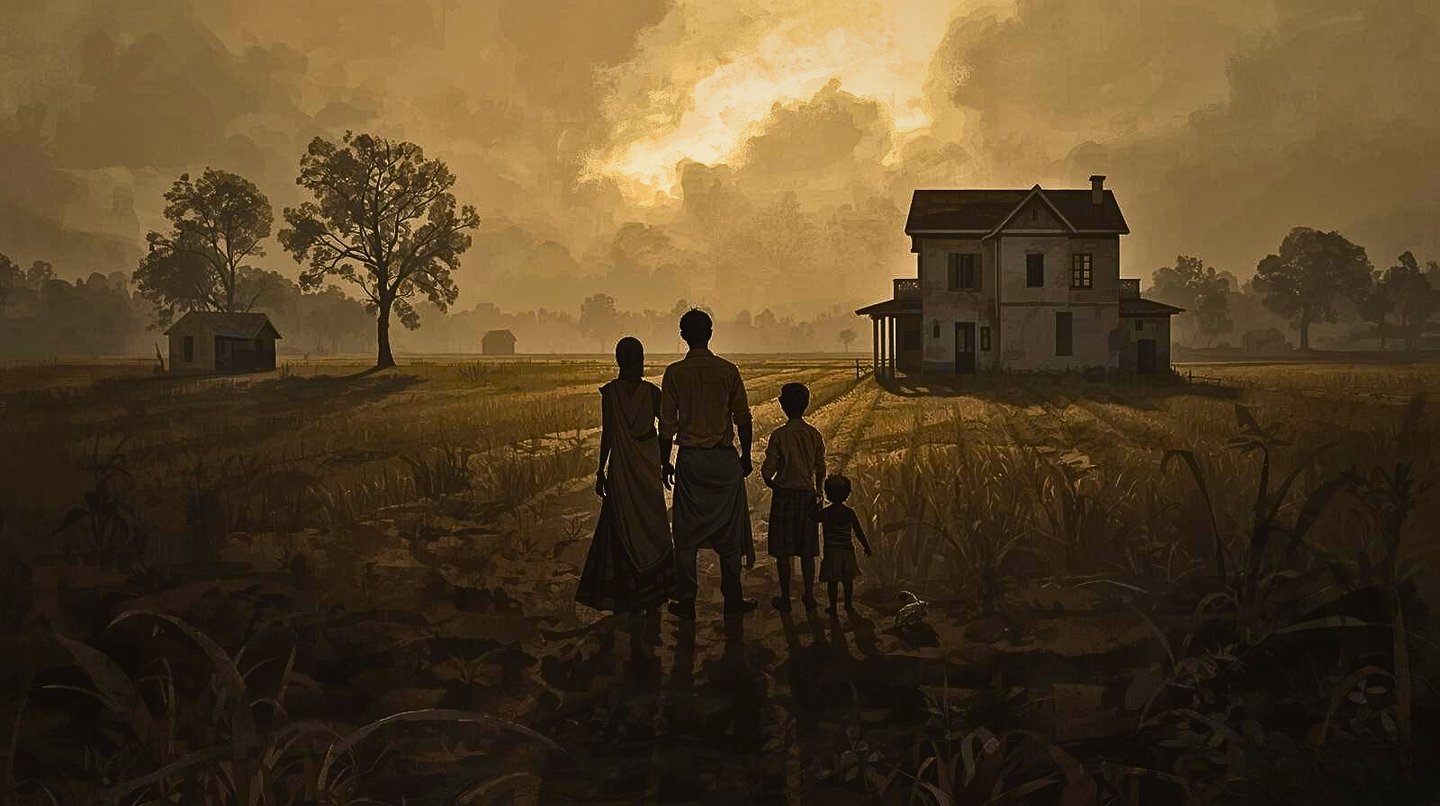
"The untold story of Athmanveshi. Chapter 1 explores the fall from a landlord legacy to extreme poverty, the depression of a father, and the resilience of a mother in a farmhouse with no lights."
Chapter 1: The King of Smoke & The Queen of Silence
Why I Write This Now
I am writing this not to gain sympathy, but to answer a question: Who is Athmanveshi?
To understand the music, you must understand the silence that came before it. To understand the seeker, you must meet the lost boy.
This is not a story of glory. It is the raw, unedited truth of how a boy born in a sheet house survived the darkness to find his own light.
The Paradox of My Birth
My story begins in a paradox.
I was born into a lineage that commanded respect. My grandfather was a dignified Engineer, a landlord with status and power. To the town, our family name was gold.
But inside the gate, my reality was different.
I was a boy living a double life: Rich by blood, but poor by fate.
The Unfinished Prince (My Father)
My father was a tragedy written in style.
He was married at 20—a boy forced to play the role of a patriarch. By 21, he held me in his arms. By 25, he was trying to lead a family in a world that demanded money he didn't have.
He was handsome. He possessed a natural grace that even poverty couldn't erase. He didn't drink. He didn't gamble.
His only escape was a hot glass of Tea and the curling smoke of a Cigarette.
I still see him sitting on the steps of our farmhouse, staring into the smoke. The "Useless" tag given to him by the relatives crushed his spirit.
I remember his handwriting—beautiful, curved, disciplined letters that looked like pearls on paper. He was an artist without a canvas.
He loved us. God, he loved us. But love doesn't pay debts. And that guilt ate him alive, turning him into a silent statue in his own home.
The Sheet House in the Dark
We lived in a farmhouse in the middle of a six-acre field.
It had strong brick walls, but the roof was made of rattling metal sheets.
We didn't even have lights.
While the town slept under electric bulbs, we lived in the flickering yellow glow of kerosene lamps. I studied watching the shadows dance on the walls.
Later, we moved into the "Big House"—the ancestral home. To the world, it looked like an upgrade. To us, it was a tomb. The walls were stone, but the jars in the kitchen were often empty.
The Partition of Blood
Poverty demands sacrifices that money can never understand.
We were two brothers. Two saplings growing in that dry soil.
My father looked at us—me and my younger brother—and realized the terrifying truth: He couldn't save us both.
To survive, a sacrifice was made.
My younger brother was sent away.
He went to live with my maternal grandparents.
I stayed.
I watched my own blood leave the house because our pockets were too light to hold two sons. The house became quieter. The silence grew heavier.
The Atlas Cycle & The Smell of Milk
With my brother gone, we had one lifeline left: The Cow.
We depended on it. Selling milk was the only way we could eat.
Initially, my father did the work. But then, fate struck again—he got hurt. He couldn't ride.
The burden fell on me.
I was in 6th or 7th standard—just 11 or 12 years old.
We had an old Atlas Bicycle. It was too big for me, heavy and rusted.
Every morning, before the sun came up, I would lift the heavy milk can and tie it to the back carrier of that cycle.
I had to ride nearly 4 to 6 kilometers.
The struggle was hardest on Saturdays.
We had morning classes. I didn't have time to go back home to change.
I would wear my uniform, load the milk can, and pedal furiously to deliver the milk to the assigned houses. Then, I would ride straight to a small shop near my school.
I would park the cycle and the empty can there, wipe the sweat off my face, and run to class.
The Miracle of the Unpaid Fee
My school wasn't just any school. It was the Number 1 standard school in the entire town.
And who owned it? My father's own sister's husband.
This was God’s strange plan for me.
I was the poor boy who smelled of milk, yet I sat in the same classroom as the richest kids in the district.
Inside those walls, I faced a different kind of fire.
When the teacher asked, "Who hasn't paid the fees?" I was the only one who stood up.
Day after day, month after month.
I stood there, head down, feeling the eyes of the class on me. The "Grandson of the Engineer" standing up for unpaid fees.
But here is the miracle: We almost never paid. We couldn't.
Yet, because of our family ties, because of God’s grace, I was allowed to stay. I was allowed to learn.
I was humiliated, yes. But I was being educated like a Prince while living like a pauper.
God was breaking my ego, but He was building my mind.
The Rusk and The Bread
In those dark days, I lived for one visitor.
My Maternal Grandfather.
He was a saint. He visited us once a month.
I would sit on the doorstep, a thin, fearful boy, waiting for his bag.
Inside, he always carried Bread and Rusk.
For others, bread is a snack. For me, it was gold. It was the taste of a life we couldn't afford. I would eat that rusk slowly, savoring every crumb, knowing it had to last until he returned.
The Magician (My Mother)
The only light in this darkness was my Mother.
She was young, barely a woman herself. She walked into this life of struggle and turned it into a home.
We had nothing. But here is the miracle: We never slept hungry.
She was a Magician.
She starved herself so we wouldn't know the taste of hunger. She swallowed the poison of our poverty and gave us only the nectar of her smile. She treated my father—the man the world mocked—like a King.
The Day the Music Died (February 2000)
I thought this struggle was my life. I didn't know it was just the prologue.
It was February. We were attending a family engagement.
We dressed up, pretending to be whole. My mother wore her old saree with the dignity of a Queen. She looked happy that day.
I spoke to her in the crowd. She smiled. Everything seemed normal.
Then, my father called me. He gave me a task—an errand to run outside the function hall.
I nodded and walked out.
As I was walking on the road, a vehicle came rushing from the opposite direction. It was speeding, tearing through the dust.
I ignored it. I just stepped aside and kept walking, thinking about my errand.
I didn't know that my entire world was in that vehicle.
A few minutes later, an auto-rickshaw pulled up beside me.
It was my cousin brother.
He looked frantic.
"Get in," he said.
"Why?" I asked. "I have to go do this work."
"Just get in!" he shouted.
I got in, confused. We drove for a short distance.
Then I saw it.
The same vehicle that had rushed past me was standing there on the side of the road.
My cousin stopped the auto. "Go look," he said.
I walked to the vehicle. I looked inside.
There she was.
My Mother. My Magician.
She was sitting there, motionless. Like a statue. Like a God who had gone silent.
For a moment, my mind refused to understand.
She is ill, I thought. She just fainted.
But there was no breath. No movement.
She was gone.
Just like that. In the time it took for a car to rush past a boy on the road, she was gone.
I stood there on that road, 15 years old.
The haunting part isn't just the death. It is that she passed right by me, and I didn't even turn to look.
The darkness had finally won.
(To be continued...)